It’s International Podcast Day, which means your feed is about to fill up with people telling you that podcasting has never been bigger and that now is the perfect time to launch a show of your own. The first half of that is true. The second half is where we’d like a word.
Podcasting really is enormous. In February 2025, YouTube said more than a billion people a month watch podcast content on its platform, and in May 2026, Spotify said more than 500 million of its users had streamed a video podcast, up nearly 50% on the year before. There is clearly a huge audience for podcasts. That isn’t the same thing as a huge audience waiting for yours, and the gap between those two statements is exactly where most new podcasters fall.
The number nobody posts on International Podcast Day
In August 2026, PodHood counted every podcast feed in the Podcast Index, all 4,711,475 of them, and checked how many were still actually publishing. Just 436,068 had released an episode in the previous 90 days. That’s 9.3%, which means more than nine out of every ten podcasts you could find today have effectively gone quiet.
The same census shows where they tend to stop. 38.9% of living feeds have three episodes or fewer, and only 23.7% have made it past episode 20. That’s before you count the 3.2 million feeds already marked dead, which PodHood notes skew short, so the true picture is probably worse.
No, 90% of podcasts don’t die after episode three
We do have to be fair here, because this is International Podcast Day, not International Scare You Off Day. You’ve probably heard that 90% of podcasts never make it past episode three. It gets repeated constantly, and nobody ever seems to know where it came from. PodHood tested it and it doesn’t hold up: even if every single dead feed had quit that early, the figure would top out at around 64%. The same goes for the idea that reaching episode 21 puts you in the top 1% of podcasts, when nearly one in four living feeds has already got there. The real numbers are sobering enough on their own, so there’s no need to make them more dramatic than they are.
Why so many podcasts go quiet
In our experience, it’s rarely because the host ran out of things to say. It’s usually a combination of three things.
The first is that recording is the easy bit. People picture a podcast as an hour of conversation every fortnight, when the actual job includes guest outreach, scheduling, preparation, editing, QA, show notes, artwork, clips, distribution and promotion, and every one of those needs someone to own it. Consistency turns out to be an operational problem far more often than a motivation problem.
The second is that podcasting is slow media. Social media has trained all of us to expect instant feedback, but with a podcast, and particularly an audio one, hundreds of people can listen without ever saying a word. If attention was the main reason for starting, that silence gets old very quickly.
The third is starting without knowing what the podcast is actually for. A show with 200 of exactly the right listeners that brings in two big clients can be doing its job brilliantly, while a show with 20,000 listeners and no commercial impact might be failing at the job it was meant to do. If you don’t know what the job is, you have no way of telling whether it’s working.
What we’ve learned making two podcasts
We make No Bullsh*t Talks, our in-person video interview show, and Sniffing Out the Bullsh*t, a research-led solo audio podcast, and between them they’ve taught us most of these lessons the hard way.
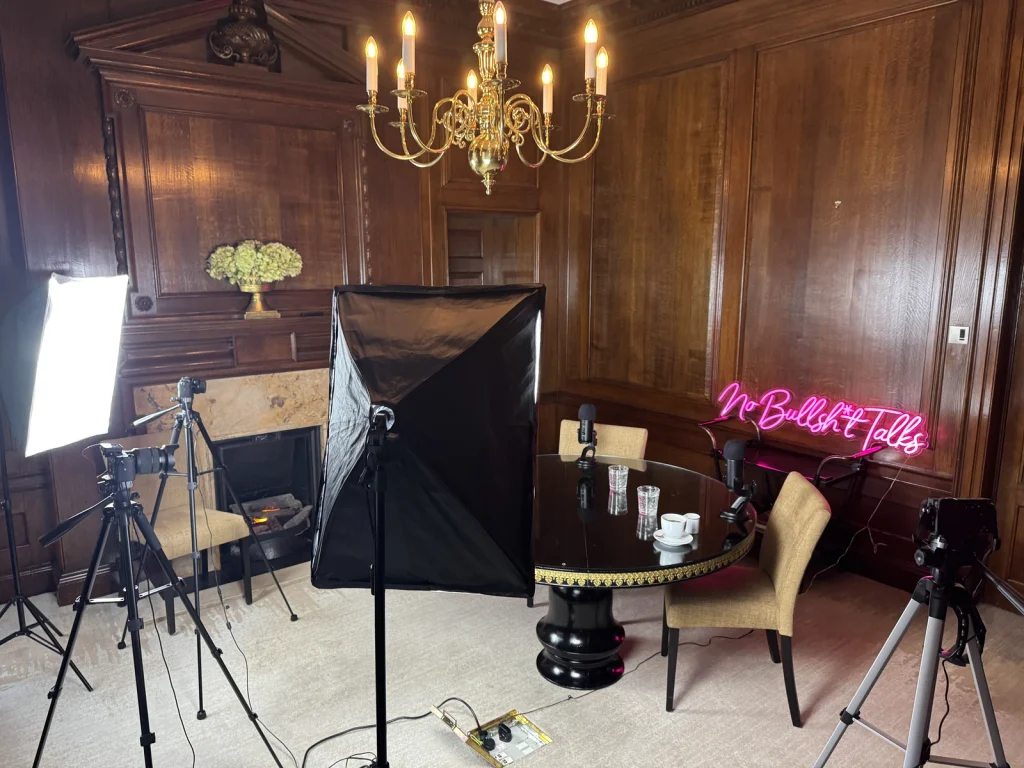
No Bullsh*t Talks didn’t start in a private members’ club with 4K cameras. Season One was recorded remotely on Zoom on a small budget, Season Two was the first time we got into a room together (and made plenty of production and editing mistakes along the way), and Season Three brought live audiences and recordings in Miami. Every season got better because the one before it existed.
That’s the thing we’d most want someone to hear before they start. You don’t need the finished version on day one, but you do need a version you can keep making. Video, for example, gives you far more to work with and far more work, and the space between those two is where a lot of shows quietly stall.
So, should you start a podcast?
Probably yes, if you have something genuinely worth discussing, you know who it’s for and what job it’s doing for your business, and you’re prepared to keep going through a first 20 episodes that might not get much applause.
Probably not yet, if you’re mainly chasing virality, you’re already struggling to keep up with the content you have, or you’re relying on enthusiasm to carry you indefinitely.
Neither answer is a failure. Finding out you’re not ready before you’ve bought the microphones is far cheaper than finding out after episode six.
Get the guide
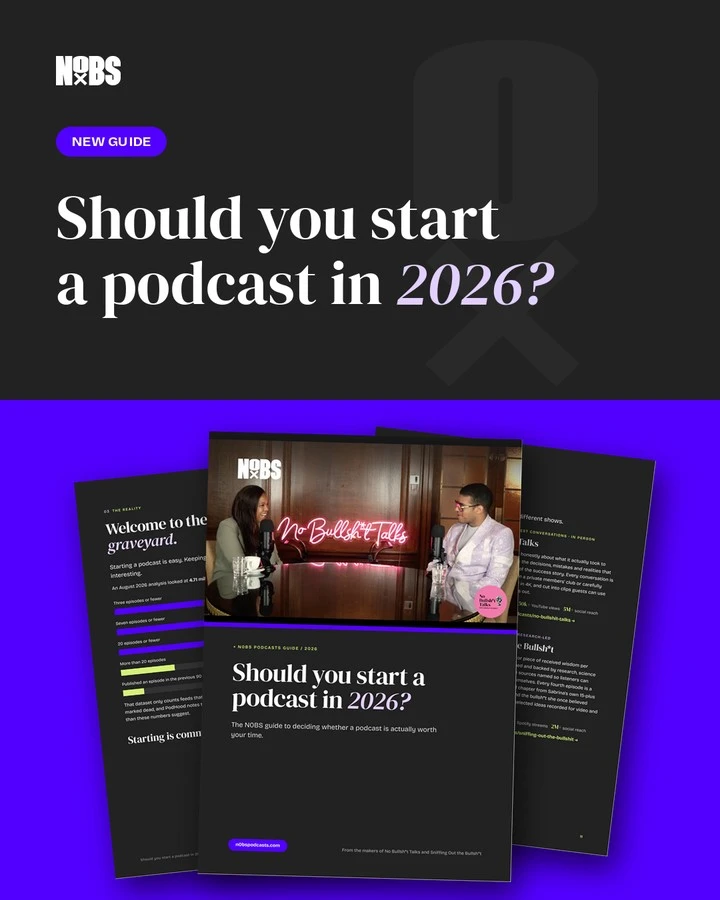
We’ve put everything we know about that decision into Should You Start a Podcast in 2026?, the N0BS guide to working out whether a podcast is actually worth your time. It covers the real reasons to start (and the bad ones), audio versus video, what a podcast really costs in money and time, how to get guests to say yes, and the 14-question N0BS podcast test to take before you hit record.
If you want to see what a properly built podcast looks like behind the scenes, you’ll find both of our shows, every episode and the Insights that come out of them at n0bspodcasts.com. And if you’d rather think decisions like this through with other founders who’ll tell you the truth, you can find out more about N0BS membership here.
Happy International Podcast Day.
Get the podcast guide
Everything to think through before you hit record, sent straight to your inbox.